
FFE Engineering Research Project
FFE Machinery Engineering Department presents innovative automation solutions for precision manufacturing processes, focusing on advanced deburring technology, robotic systems optimization, and intelligent vision inspection capabilities.
Ultrasonic Deburring: Next-Generation Precision Finishing
Technology Overview
Revolutionary automated deburring combines ultrasonic horn technology with 6-axis robotic manipulation, eliminating manual scraping while achieving 100% burr removal. This system delivers sharp-edged, burr-free components without material removal or surface modification.
Leveraging proven success with Swiss watch manufacturers, we’ve developed deep expertise in addressing precision manufacturing challenges for miniature components requiring micron-level accuracy.
Process Advantages
- Zero material removal maintains tight tolerances
- No surface discoloration or deformation
- Access to hidden burrs and cross-hole features
- Eliminates scratching risk from manual tools
- Consistent quality across all components
1
Current Manual Process
Baito scraper, finger coat, nylon brush operation under microscope. Risk of scratching. Labor: 13-30 operators. Cycle time: 30-60 min/piece.

2
Automated Solution
Ultrasonic horns with 6-axis robot. Production: 1,500 pcs/day (100 sec/piece). Labor: 1 operator. Estimated investment: 800K RM


Results from Swiss Watch Manufacturer Testing: Successful validation across multiple component geometries demonstrates process robustness and repeatability for high-precision applications.
Delta Robot Performance Enhancement Initiative
Our ongoing research focuses on developing cost-effective, high-performance motor modules that deliver superior repeatability and user-friendly operation. Through systematic evaluation of different motor technologies, we’ve achieved significant cost reductions while improving precision capabilities.
Evolution of Delta Robot Technology at FFE
2017-2019: Initial Development
First unit deployed in EPJ using Swiss precision motors. Established baseline performance with 5μm repeatability but at premium cost (RM 350K).
.
2022: Horizontal Deployment
Scaled to 5 additional Hozomigaki units, reducing workforce by 5 operators. Integrated inline inspection for mix-part prevention.
.
2025: Mitsubishi Upgrade
Transitioned to Mitsubishi Motion Robot Module (FFE Ver 2.0). Achieved sub-10μm repeatability with 2× speed improvement at RM 90K total cost.
2020-2021: Sanyo Integration
Developed FFE Ver 1.0 with Sanyo Motion Robot Module. Successfully completed one-year test run demonstrating viability of alternative motor solutions.
.
2023-2024: Performance Crisis
Encountered repeatability issues during COVID disruptions. PIC project team resignations led to loss of specialist support.
2026: Optimization Phase
Evaluating Oriental Motor modules (RM 18K) for further cost reduction while maintaining precision performance.
.
Comparative Performance Analysis

Key Achievements
- 74% cost reduction from initial Swiss system to FFE Ver 2.0
- 2× speed improvement with Mitsubishi motor integration
- 5-operator reduction through horizontal deployment
- Inline inspection capability prevents component mixing errors


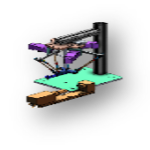

Next-Generation Pick & Place: Vision-Guided Free Picking
Revolutionizing component handling through intelligent vision systems combined with precision delta robotics and adaptive soft grippers—enabling flexible, multi-model production with rapid changeover capabilities.
System Architecture

SEC Vision Feeder
Custom-designed vibration feeder provides controlled part presentation while maintaining compact footprint for space-constrained production environments.

EPJ In-House Delta Robot
Precision robotics achieving <10μm repeatability with 100mm stroke capability and customizable gripper adaptor system.

Adaptive Soft Gripper
Advanced gripper technology prevents surface damage (dents, dings, scratches) while accommodating complex geometries and varying component shapes.
Key Capabilities
- Utilizes flicker feeder as universal part presentation system
- Intuitive programming interface simplifies setup procedures
- Multi-model flexibility supports diverse component portfolios
- Rapid 3-step changeover: plug-in nozzle replacement, orientation plate exchange, program selection




Horizontal Deployment Strategy
Expanding application beyond initial use case to additional manual processes throughout R&D operations. System’s flexibility and ease of use make it ideal for small-batch, high-variety production scenarios requiring frequent model changes.
Engineering Technology Development
Strategic technology partnerships and capability development initiatives to address critical manufacturing challenges and enhance production capabilities.
Advanced Vision Inspection: AI-Powered Defect Detection
EPJ requires next-generation vision solutions combining high-resolution imaging for microscopic component inspection with artificial intelligence learning capabilities to identify multiple defect types at production speeds.
Challenge: Component Size Constraints
Watch part components demand exceptional resolution for accurate defect detection. Current high-resolution camera options are limited, with Keyence providing the best precision but at the cost of processing speed

Chinese Vision System Capabilities
Advanced vision systems observed at international exhibitions demonstrate impressive processing speeds. These systems integrate AI-powered defect learning algorithms that can rapidly identify and classify multiple defect types.
Keyence System Limitations
While Keyence cameras deliver exceptional resolution for small and precise component inspection with superior accuracy, their processing speed creates production bottlenecks. The throughput limitation restricts deployment in high-volume manufacturing environments.
Required Solution Specifications
EPJ seeks vision inspection technology that combines high-resolution imaging suitable for microscopic watch components with AI learning capabilities for multi-defect identification—all while maintaining production-compatible processing speeds.
Keyence Performance Profile
- Superior resolution: Optimal for small, precision components
- High accuracy: Excellent defect detection capability
- Processing speed limitation: Creates production bottlenecks
- Limited scalability: Throughput constraints for volume production
Target Capability Requirements
- High-speed processing: Production-compatible throughput
- AI defect learning: Self-improving detection algorithms
- Multi-defect identification: Comprehensive quality assurance
- Microscopic resolution: Suitable for watch components
Strategic Vision Request
EPJ requires vision inspection solutions with AI learning capabilities to identify multiple defect types while maintaining the high resolution necessary for precision watch component manufacturing.
Automated Chemical Dipping: Eliminating Process Variability
Manual chemical dipping operations introduce quality risks through timing inconsistencies and operator error. Automated control system ensures precise immersion duration while preventing over-dipping damage to critical components.
Manual Process Risks

- Operator timing errors cause over-dipping
- Manual timer setting lacks precision
- Quality defects from extended immersion
- Cycle time: 10-30 minutes depending on part type
Automated Solution (26.75K RM)
Programmable dipping sequence with automatic basket lifting eliminates timing variability. System uses N.S. Clean 100W and M.D 100 chemistries with precise duration control.
- Automated rise after washing completion
- Programmable cycle times: 10, 20, 30 minutes
- Prevention of over-dipping damage
- 50% cycle time reduction: 1 tray per 1.25 hours

Corrosion Damage
Extended chemical exposure causes material degradation and structural weakness
Color Change
Surface discoloration indicates excessive chemical interaction with base material
Yogore (Stain)
Chemical residue creates cosmetic defects requiring rework or component rejection
50%
Cycle Time Reduction
From 3.5 hours to 1.25 hours per tray through automated control
24
Operating Hours
Continuous operation capability vs. 8-hour manual shifts
0.5
Labor Reduction
Headcount decrease while maintaining production volume
Magnetization Process Control: Poka-Yoke Implementation
Barrel magnetization process requires precise rotation counts (2, 4, or 8 rotations) for complete magnetic field exposure. Manual operation introduces counting errors compromising magnetization uniformity and component quality.
1
Manual Operation
Operator-dependent counting of barrel rotations. High reliance on worker attention and self-discipline creates error opportunities.
2
Automated Control
PLC-based rotation counting with sensor verification. Push-pull mechanism executes 90° turns with position confirmation.
3
Quality Assurance
Electronic counter provides traceability and verification. Eliminates miscounting while maintaining operator efficiency.


System Architecture
Second-generation barrel lifting unit employs push-pull actuation for controlled rotation. Sensor array verifies barrel position at each 90° increment, triggering timer sequences for magnetization duration.
PLC controller manages motion profile while maintaining rotation count for operator verification and process documentation.
Part Loading
Components transferred into tray and positioned inside barrel fixture for magnetization process
Magnetization Cycle
Barrel positioned in magnetizer unit. Timer initiates exposure sequence for specified duration
Rotation Control
Automated barrel rotation through two required positions ensures complete magnetic field coverage

Unloading Sequence
System verifies rotation count completion before enabling barrel removal from magnetizer unit


EPJ
Advancing Precision Manufacturing Through Innovation
FFE Machinery Engineering Department continues driving automation excellence through strategic technology development, cost optimization, and quality enhancement initiatives across precision manufacturing operations.
Ultrasonic Deburring
Revolutionary burr removal without material loss, eliminating manual scraping while achieving 100% defect removal
Vision-Guided Picking
Flexible part handling with rapid changeover capability, supporting multiple component variants
Delta Robot Platform
70% cost reduction through intelligent component selection while maintaining sub-10µm repeatability
AI Vision Inspection
Collaborative development opportunity for high-speed, high-resolution defect classification systems